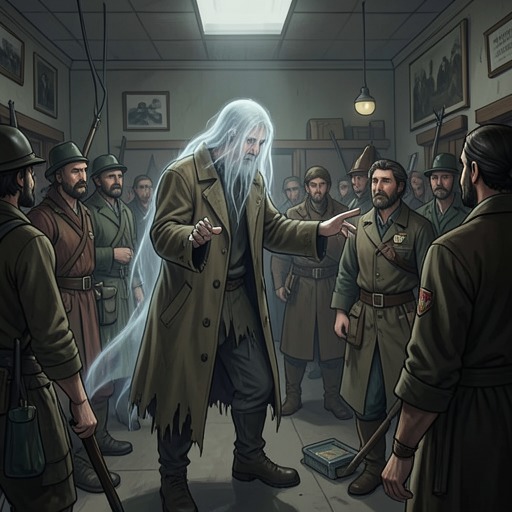
Lestat and Julien
Blood CanticleLestat and Julien are locked in a conflict over intervention, responsibility, and who has the right to shape the Mayfair family’s fate. Julien’s concern for the family keeps him interfering despite repeated failures; Lestat, himself torn between guilt and the desire to do good, finally tells Julien to leave the living to their own conscience and fortune, then forcibly casts him away. Their opposition exposes a central tension in Lestat’s moral life: he rejects Julien’s claim to guide others even as he struggles to understand whether his own powers can serve anything but harm.
A Conflict Shaped by Guilt and Failed Intervention
Julien’s efforts to influence events have, in Lestat’s view, brought serious consequences. Lestat reminds him that he aided Mona in coupling with Michael, and that the birth of Morrigan destroyed Mona. He also distinguishes this outcome from Merrick’s transformation: entrusting Merrick to the Talamasca, he says, was not Julien’s fault. That distinction makes Lestat’s rebuke more than a blanket accusation. He calls Julien to recognize the limits of his knowledge and to stop turning mistakes into reasons for further interference.
The dead and the lost remain at the heart of the dispute. Lestat tells Julien that Lasher and Morrigan are dead and insists that Julien must let go of the Mayfairs. Julien, however, asks whether Lestat will let them go, then clarifies that Mona is lost to him and shifts attention to the fate of the entire clan. He asks whether the woman Lestat covets has redeemed the family’s wealth and sanctified its power. His plea reveals that his concern has widened from individual loved ones to the destiny of the family as a whole, while Lestat refuses to provide the reassurance he seeks.
Earlier Encounters and Spiritual Authority
Julien’s contact with Rowan is described as rare and purposeful: he came to her long ago when he wanted her to do something, and those appearances occurred in dreams. Rowan says that Julien is in the Light and does not return to Earth without an important reason. Her account presents him as a figure who has exercised influence from beyond ordinary life, but does not establish that every later appearance has the same purpose or authority.
Lestat’s own relation to spiritual authority is uncertain. In the Sistine Chapel, he longs to become a priest and consecrate the host, and insists that he does not want to do evil. Yet the imagined scene dissolves: he recognizes that he is not a saint and is not even physically in the chapel. He also acknowledges that he lives by blood and considers himself ritually impure. This conflict helps explain why Julien’s appeal to the Mayfairs’ destiny cannot simply command his assent. Lestat wants moral purpose, but distrusts claims that supernatural power or noble intention guarantees goodness.
Lestat’s Limits and Julien’s Challenge
After transforming Mona, Lestat feels profound contrition and believes that his powers and talents can produce only evil. His self-condemnation gives the later dispute with Julien a personal edge: both men have acted upon the Mayfairs, and Lestat cannot claim innocence merely because he condemns Julien’s interventions. His resistance is instead directed at the cycle in which a failed attempt to help becomes grounds for another attempt to control events.
Their disagreement also takes place against Lestat’s broader uncertainty about good and evil. He argues that the deeper theological problem may be explaining the existence of good, rather than explaining evil, and later questions whether his actions have done any good at all. His successful effort to guide Patsy toward the Light offers him a rare counterexample to despair, but it does not settle the matter. When he recalls that Julien did not care for Patsy’s soul, he accuses him of ignoring his own descendants, linking their conflict over spiritual intervention to their shared connection with the family.
The Final Confrontation
At the Medical Center, Julien challenges Lestat over his continuing involvement with the Mayfairs, accusing him of seeking excuses to draw close to Rowan and urging him to seek the Light. Lestat answers that Julien cannot sway him and demands that Julien take his curse from him. He reaches for Julien, shuts his eyes, and experiences the encounter as a confrontation between the vampiric spirit animating his own flesh and the force Julien uses to project an image of himself.
Lestat then sends Julien a force of rejection rather than the love with which he had helped Patsy. He wills Julien away from the Earth and strikes him with the full strength of his arm, driving him beyond sight. Julien’s anguished cry marks the end of the encounter; Lestat is left alone outside the Medical Center. The contrast with Patsy’s departure is decisive: Lestat had used love to guide her toward the Light, but he uses repudiation to break Julien’s hold on him. The scene settles their immediate confrontation without resolving Julien’s concern for the Mayfairs or Lestat’s deeper uncertainty about whether his power can do good.